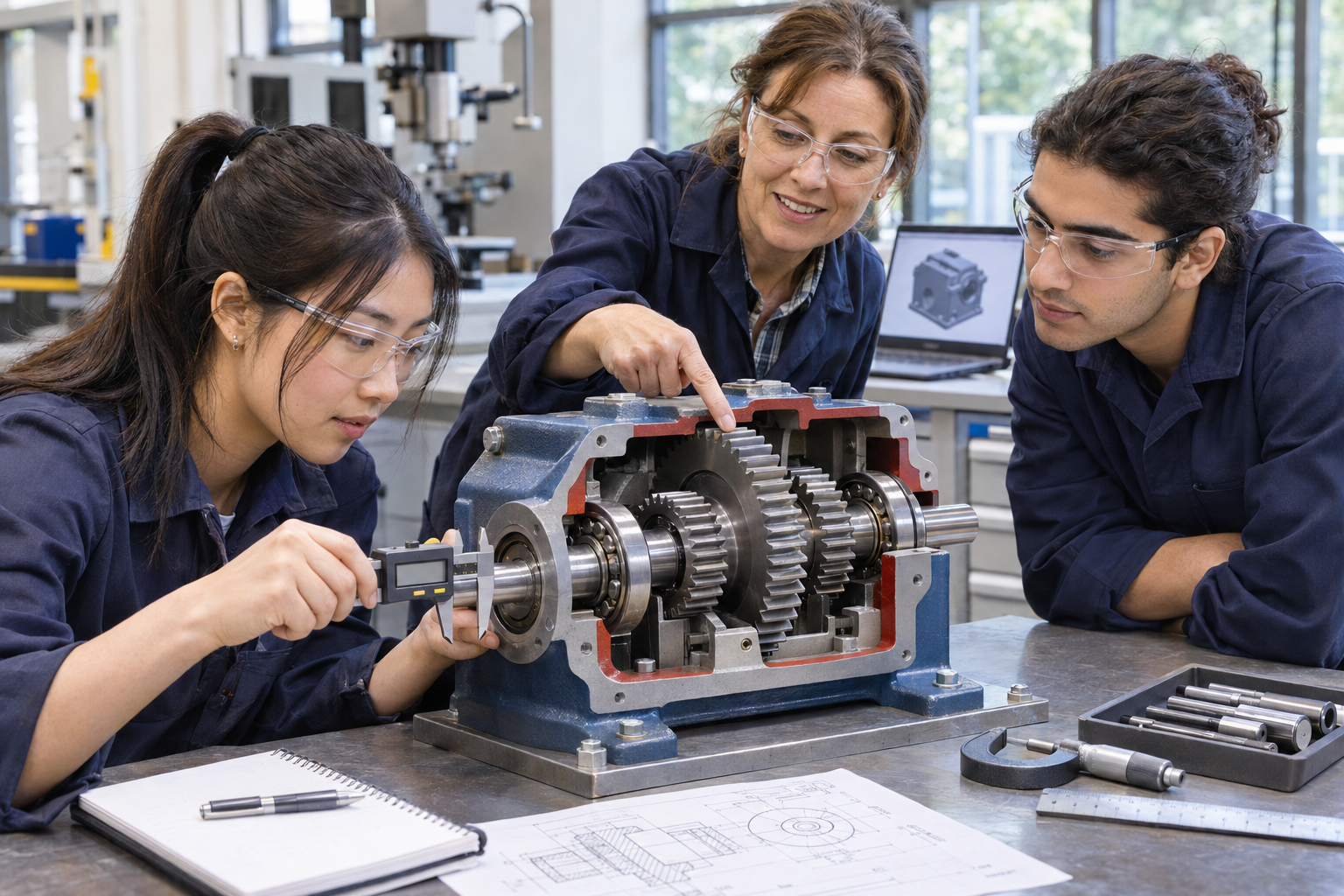
ENGINEERING

Study Mechanical Engineering Overseas

Explore mechanical engineering degrees, study pathways and university options in the UK and Australia. Discover how mechanics, materials, energy and engineering design are used to develop machines, products and systems across a wide range of industries.

What is Mechanical Engineering?

Mechanical engineering applies mathematics, physics and engineering principles to designing, analysing, manufacturing and maintaining mechanical products and systems. It explores how forces, motion, materials and energy interact. Mechanical engineers help develop solutions ranging from everyday products and industrial machinery to transport systems, energy equipment and medical devices.

Students build a foundation in engineering mathematics, mechanics and materials. They investigate how components respond to loads, how machines move and how material properties influence performance. Understanding stress, deformation, vibration and failure helps students assess whether a design can operate safely and reliably under its intended conditions.

The subject also examines energy, heat and fluid flow. Through thermodynamics, heat transfer and fluid mechanics, students explore processes used in engines, pumps, cooling systems and power generation. They learn to analyse efficiency, identify losses and consider ways to reduce energy use and environmental impact while meeting practical requirements.

Engineering design connects scientific understanding with practical problem-solving. Students learn to define requirements, develop concepts and use computer-aided design and simulation to evaluate options. Manufacturing studies introduce processes, tolerances and material selection, helping students consider how products can be made, assembled, maintained and eventually reused or recycled.

Practical learning may include laboratory experiments, workshop activities, prototypes and individual or team design projects. Depending on the programme, students also explore control systems, mechatronics, robotics or computational methods. They develop skills in analysing data, testing assumptions, communicating technical decisions and balancing safety, cost, sustainability and user needs.

Mechanical engineering degrees differ in their qualification level, specialist options, accreditation and industry experience. Compare the exact programme, campus, design projects and placement arrangements before applying. An academic degree is one stage of professional development: registration or chartered status, where relevant, may require further learning, assessed experience and professional review. An engineering technology qualification may lead to a different professional pathway from an engineering degree.

What Will You Study?

Engineering Mathematics, Mechanics & Materials

Develop mathematical methods for analysing engineering problems. Study forces, motion, stress, deformation and vibration to understand how components and structures behave. Explore material properties, selection and failure, considering how operating conditions and manufacturing processes affect the safety, durability and performance of mechanical systems.

Thermodynamics, Fluids & Energy Systems

Explore how energy is transferred and converted, how heat moves and how liquids and gases behave. Apply these principles to equipment such as engines, pumps, turbines and cooling systems. Learn to evaluate efficiency, pressure losses and thermal performance while considering energy use and environmental impact.

Mechanical Design, CAD & Manufacturing

Learn to turn requirements into engineering concepts, drawings and detailed designs. Use computer-aided design (CAD) and simulation to assess components and assemblies. Explore manufacturing methods, tolerances, material choices and design for assembly, considering cost, maintenance, sustainability and the practical constraints of production.

Control Systems, Experiments & Engineering Projects

Explore measurement, instrumentation and the control of mechanical systems, with mechatronics or robotics included in some programmes. Develop practical skills through laboratory experiments, prototypes and design projects. Analyse data, evaluate assumptions and communicate technical decisions while building teamwork, project planning and awareness of engineering ethics and safety.

These are typical study areas for mechanical engineering degrees. Specialist options, software, workshop activities, design projects and industry placements vary by university and programme. Placements may be optional or subject to separate selection. Check the exact qualification, campus and accreditation status, along with any further learning or experience needed for your intended professional pathway.

Entry Requirements & Study Pathways

Your pathway into mechanical engineering depends on your academic qualifications, mathematics and science background, and the requirements of your chosen university. Compare degree structures, foundation or diploma pathways, credit transfer opportunities and professional accreditation. Courses in engineering and engineering technology may lead to different professional outcomes.

Your Qualification Possible Study Pathway
Singapore O Levels Further study through A Levels, the IB Diploma or an accepted engineering foundation or diploma programme may help you meet undergraduate entry requirements. Confirm that the pathway leads to your intended mechanical engineering degree and includes the required mathematics and science subjects. Check progression grades, available universities and any conditions for entering a particular degree route.
Singapore A Levels / IB Diploma You may be eligible for direct entry into an undergraduate mechanical engineering programme, depending on your results and subject combination. Check the required level of mathematics and whether physics or another science is compulsory. Where the university offers both bachelor’s and integrated master’s routes, compare their entry requirements and conditions for transferring between them.
Polytechnic Diploma Your application will be assessed against the university’s requirements, including your diploma discipline, GPA and relevant modules. Provide details of engineering mathematics, mechanics, thermodynamics, materials, design and practical projects where relevant. Credit transfer or advanced entry is assessed individually and is not automatic. Check the remaining study duration, prerequisite subjects and whether your proposed study pathway meets any professional accreditation or recognition requirements.
Bachelor’s Degree Graduates can explore taught or research postgraduate programmes in mechanical engineering and related fields, subject to academic results and prerequisite knowledge. Many courses require a relevant engineering degree, while some consider closely related disciplines. Distinguish specialist postgraduate study from programmes designed to provide an initial professional engineering qualification. A master’s degree does not automatically resolve gaps in an earlier qualification’s accreditation or recognition.

Additional Admission Requirements

Depending on the programme, you may need specific mathematics and science subjects, evidence of English language proficiency, references or a personal statement. Applicants seeking credit transfer may need detailed module descriptions, while research applicants may require a proposal and an available supervisor. Check international student eligibility, application deadlines, project or equipment costs, and whether industry placements are included, optional or competitive. Before enrolling, confirm the exact qualification, campus, study mode and accreditation coverage for your intended intake and professional pathway.

Featured Universities

Explore mechanical engineering degrees in the UK and Australia. Compare engineering design projects, laboratory facilities, specialist subjects and industry experience, alongside entry requirements and the accreditation applicable to your intended programme.

United Kingdom

Illustration of the University of Sheffield campus

University of Sheffield

BEng Mechanical Engineering

Build a foundation in mechanical engineering principles through a three-year bachelor’s degree. Explore how scientific analysis and engineering design support the development of mechanical systems. An integrated MEng route is also available, with opportunities to transfer subject to performance and university requirements. Compare the academic and accreditation outcomes of each route.
Illustration of the Teesside University campus

Teesside University

BEng (Hons) Mechanical Engineering

Explore mechanics, thermodynamics, materials, digital engineering and manufacturing through laboratory work and design projects. Practical opportunities include Formula Student activities and an optional industry year. Foundation-year and integrated MEng routes are also available. Confirm placement availability and the accreditation coverage for the exact course, study location and intake.

Australia

Illustration of the Monash University campus

Monash University

Bachelor of Engineering (Honours)
Mechanical Engineering Specialisation

Study mechanical engineering within Monash’s honours engineering programme at its Clayton campus. Explore areas such as fluid mechanics, dynamics and engineering design, with practical opportunities through student teams including Monash Motorsport and Nova Rover. The engineering programme is accredited by Engineers Australia at the Professional Engineer level.
Illustration of the RMIT University campus in Melbourne

RMIT University

Bachelor of Engineering (Mechanical Engineering) (Honours)

Develop mechanical engineering knowledge through a four-year honours degree combining engineering science, design and practical laboratory learning. Explore industry-relevant projects and opportunities to develop specialist interests in areas such as manufacturing and automotive engineering. The programme is fully accredited by Engineers Australia.

These are selected examples rather than a ranking or a guarantee of admission, employment or professional registration. Specialist subjects, project opportunities and placements vary by programme. Confirm the exact qualification, campus, study mode and accreditation coverage for your intake. Industry placements may require separate applications and are not guaranteed by admission to a degree.

Choose Your Degree With Your Professional Goal in Mind

Degree accreditation and an individual’s professional registration are separate. UK BEng and MEng programmes may meet different academic requirements for Chartered Engineer registration. Australian accreditation also does not automatically confer Singapore Professional Engineer status.

If Singapore PE registration is your goal, review the Professional Engineers Board’s requirements before choosing your course. Check any conditions affecting advanced entry, diploma exemptions, top-up qualifications, overseas delivery or supplementary postgraduate study.


Check Singapore PE Requirements ↗

Looking for Other University Options?

Every student is different. We can help you compare mechanical engineering degrees and pathways based on your qualifications, budget, practical interests and career goals.


Discuss Your Study Options

Professional Recognition & Registration

An accredited engineering degree and registration as a professional engineer are different. Accreditation assesses an academic programme against professional standards. Registration assesses an individual’s qualifications, competence and experience. Completing a degree does not automatically make you a Singapore Professional Engineer or a UK Chartered Engineer.

Becoming a Professional Engineer in Singapore

For graduates planning to pursue registration in mechanical engineering, the standard pathway through Singapore’s Professional Engineers Board (PEB) involves the following requirements. Examination eligibility and practical experience requirements should be checked directly with PEB.

Requirement What It Involves
Approved qualification Hold a qualification that meets PEB’s approved qualification requirements for mechanical engineering, including any applicable conditions or supplementary study.
Fundamentals examination Meet the eligibility requirements and pass the Fundamentals of Engineering Examination (FEE).
Relevant practical experience Acquire at least four years of acceptable practical experience. Mechanical engineering applicants must meet the required Singapore experience, supervision and work-content conditions, including at least two years of relevant work in Singapore under a registered Professional Engineer with a valid Practising Certificate.
Professional practice examination After passing the FEE and meeting the relevant experience requirements, pass the Practice of Professional Engineering Examination (PPE).
Registration assessment Submit the required evidence of qualifications and experience, attend the professional interview and satisfy PEB’s registration requirements.

This outlines the standard route for new applicants. Detailed conditions apply to the timing, recency, supervision and nature of practical experience. Refer to PEB’s current guidance for your individual circumstances.

View Official PEB Registration Requirements ↗

Choosing a Degree for Your Professional Goal

Before enrolling, check the exact qualification, engineering discipline, university, campus and accreditation coverage for your intake. If you plan to seek Singapore PE registration, also check PEB’s qualification requirements. Overseas accreditation or recognition under an international agreement should not be treated as automatic eligibility for registration.

For UK Chartered Engineer (CEng) registration, an accredited integrated MEng is one recognised academic route. An appropriately accredited honours bachelor’s degree may require further learning to master’s level. Applicants must also demonstrate professional competence and commitment through the relevant professional assessment.

If you are considering diploma exemptions, advanced entry, a top-up degree or study across different institutions, check how the complete study arrangement affects your intended professional pathway. Do not assume that adding any master’s degree will automatically satisfy Singapore PE or UK CEng requirements.

Explore UK Chartered Engineer Requirements ↗

Career Opportunities

Mechanical engineering graduates can explore careers designing, analysing, manufacturing and maintaining products and systems across a wide range of industries. Opportunities depend on your technical knowledge, practical experience, specialist interests and the requirements of individual employers. Some responsibilities require additional training or professional registration.

Mechanical Design & Product Development

Develop components, machines and products from initial requirements through to detailed design and testing. Work may involve computer-aided design, engineering calculations, simulation and prototype evaluation. Collaborate with manufacturing and commercial teams to balance performance, safety, cost, reliability and the needs of users.

Manufacturing & Production Engineering

Help develop and improve processes used to manufacture parts and assemble products. Responsibilities may include selecting production methods, designing tooling, investigating defects and improving workflow. Build expertise in quality control, automation and process improvement, with further training suited to the materials and equipment involved.

Energy & Thermal Systems

Apply thermodynamics, heat transfer and fluid mechanics to equipment such as pumps, turbines, heat exchangers and cooling systems. Support design, performance analysis or improvements in energy efficiency. Opportunities may span power generation, renewable energy, industrial utilities and building services, depending on your training and experience.

Maintenance, Reliability & Asset Engineering

Help organisations keep mechanical equipment operating safely and reliably. Work may include analysing failures, reviewing inspection findings, planning maintenance and recommending equipment improvements. Develop knowledge of condition monitoring, risk assessment and asset performance, with specialist responsibilities requiring appropriate experience and authorisation.

Automation, Robotics & Mechatronics

With suitable control, electronics and programming skills, contribute to automated machines and robotic systems. Opportunities may involve designing mechanisms, selecting actuators, integrating sensors or testing system performance. Specialist roles can require further study or practical training beyond the mechanical engineering content of your degree.

Research, Consultancy & Engineering Leadership

With relevant experience, contribute to engineering investigations, technical consultancy, project delivery or team leadership. Research opportunities may involve new materials, manufacturing methods or mechanical technologies. Advanced research and academic positions commonly require postgraduate qualifications, while senior professional responsibilities may require registration and assessed competence.

These are examples of career directions rather than guaranteed outcomes. Some roles require specialist technical training, relevant experience or postgraduate qualifications. Completing an engineering degree does not automatically confer Chartered Engineer status or registration as a Singapore Professional Engineer. Check the requirements for your intended responsibilities and country of work.

Let’s plan your next step

Tell us about your qualifications and mechanical engineering study goals.


Enquire about studying mechanical engineering →

Entry requirements and available pathways vary by institution and course.